As a rising star in the material industry, bio-based materials have a vast territory, and there are not only substitutes for traditional petroleum-based plastics, such as bio-based PE, PET, PP and other products. It also includes a series of new bio-based biodegradable materials such as PHA and PLA.

Statistical analysis of bioplastics production capacity released by Nova in 2020
In addition to all bio-based products, some bio-based materials are also one of the important components of bio-based products. Some bio-based PE materials, blends of natural materials and petroleum materials, etc. So how are the bio-based materials that are not significantly different from traditional materials in appearance and performance, and how to detect the content of bio-based materials in the product? Regarding the certification of bio-based products, the United States Department of Agriculture has launched a special bio-based product certification mark.
So how are the bio-based materials that are not significantly different from traditional materials in appearance and performance, and how to detect the content of bio-based materials in the product?
Regarding the certification of bio-based products, the United States Department of Agriculture has launched a special bio-based product certification mark.
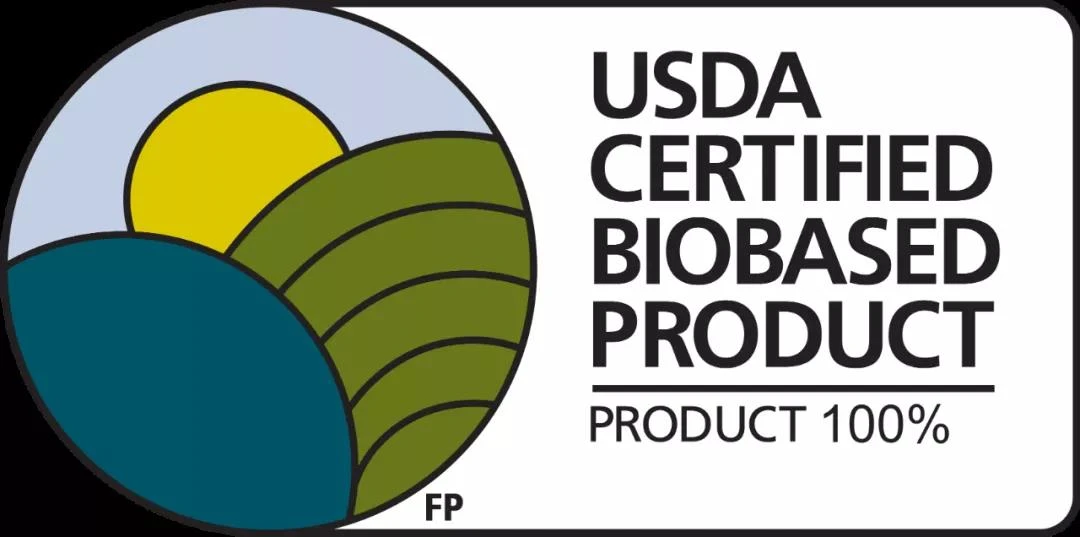
The bio-based product label of the United States Department of Agriculture indicates the specific bio-based content of the product, and the ASTM D6866 bio-based content calculation method is used to calculate the total organic carbon content in the product.
ASTM D6866 was developed in the United States as a standardized test that uses the radiocarbon test to determine the biobased content of solid, liquid, and gas samples.
So, what is radiocarbon?
Radiocarbon, or carbon 14 (also written as 14C), is an unstable and weakly radioactive carbon isotope. Carbon 14 exists in all living substances in trace amounts. It is weakly radioactive and gradually decreases after decay until the content is almost close to zero. The radiocarbon dating method measures the amount of carbon 14 in a substance to determine the last time something (or someone) was alive from the current time.
For living organisms, they absorb the relatively stable C14 in the atmosphere by maintaining a connection with the external atmosphere. Therefore, the carbon 14 content of living animals and plants and the surrounding air is the same.
When plants or animals stop eating, the intake of carbon 14 stops, and the balance of carbon 14 is destroyed. At this time, by measuring the concentration of carbon 14 in the substance, the number of decays can be obtained.
The half-life of carbon 14 refers to the time required for the radioactive decay content to decay to half of the original content. This half-life is about 5700 years, which means that every 5700 years the amount of carbon 14 in fossils is only half of what it was 5700 years ago.
This also means that if a dead plant has 50% carbon-14 compared to an active plant, the dead plant was still alive about 5700 years ago.
The time continues to extend, and after 50,000 years, there will be no radiocarbon in fossils. Carbon 14 will be completely gone when radioactive decays. When a radiocarbon dating laboratory finds that the fossil does not contain any carbon 14, it can be known that the fossil is more than 50,000 years old. Petroleum fossil materials and dinosaur bones no longer contain carbon-14.
Meaning of ASTM D6866
ASTM D6866 is now used to verify that the biological (biomass) portion of heterogeneous fuels and their carbon dioxide emissions meet the requirements of the greenhouse gas agreement. This method has been incorporated into reporting agreements in the United States, Australia and Europe. A variant of ASTM D6866 is used to monitor waste-derived fuels under the EU Emissions Trading Scheme.
The EU also allows the use of ASTM D6866 to monitor other types of heterogeneous fuels. The Australian government has incorporated similar recommendations into the recommendation to use ASTM D6866 for blended fuels. The UK's Renewable Obligation Certificate Program is also considering adopting this method to monitor biomass energy production. This method has also been incorporated into the United Nations Clean Development Mechanism method for solid waste management.


