Preparation and application prospect of bio-based polylactic acid fibers
Bio-based PLA materials were synthesized by the French in 1913 by polycondensation. After decades of development, high-molecular-weight PLA was prepared by DuPont in 1954 by a two-step method. In 2000, China launched the industrialized and large-scale application of PLA.
PLA fiber material is a new type of bio-based degradable material. It is a polymer obtained by polymerizing lactic acid as the main raw material. The source of raw materials is sufficient and renewable. It mainly uses corn, cassava, etc. as raw materials. Melt spinning, electrospinning, etc. Processed in a variety of ways. PLA fiber material has good biocompatibility, easy degradation and regeneration, etc., which makes it have good application prospects in the fields of biomedicine, filtration and separation, and packaging. This study mainly discusses the preparation, application and recycling strategies of bio-based PLA fibers.
1.Preparation method of PLA
PLA is a thermoplastic aliphatic polyester, and its monomers have two optical isomers, dextro-lactic acid (PDLA) and lev-lactic acid (PLLA), both of which are isotactic and can form crystals under appropriate conditions. . The synthesis of PLA includes three methods: direct polycondensation, ring-opening polymerization, and azeotropic dehydration condensation, as shown in Figure 1.
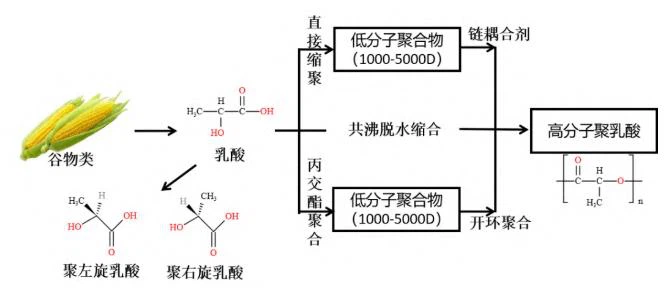
The direct polycondensation method requires dehydration polycondensation of hydroxyl and carboxyl groups at equimolar concentrations to obtain low molecular weight polymers, and then through coupling agents or esterification accelerators to obtain high molecular polylactic acid. The cost is low, but two-step polymerization is required, and impurities are not easy to The azeotropic dehydration and condensation method avoids the use of esterification accelerators, and the increase in the boiling point of the solvent increases the rate of polymerization; the ring-opening polymerization method can precisely control the chemical structure of PLA under the action of a catalyst to obtain specific products.
2. Preparation method of polylactic acid fiber
2.1 Melt spinning
The melt spinning method uses polymer melt as raw material, extrudes through spinneret holes, and condenses rapidly in the air to solidify into fibers. The melt spinning process is simple, the spinning solution is the melt of the fiber-forming polymer itself, and there is no need to recycle the spinning solvent or the coagulation bath, and the fiber forming process is completed in the gas phase, with low frictional resistance, and a higher temperature can be used. Winding speed, high production efficiency. However, not all fiber-forming polymers can be melt-spun to prepare fibers. One of the conditions for preparing fibers by melt-spinning is that the melting temperature of the polymer must be lower than its thermal decomposition temperature by about 30 °C, otherwise it is difficult to use classical melting. method for spinning.
The production process of polylactic acid melt spinning is similar to the spinning process of polyethylene terephthalate, and it is divided into one-step high-speed spinning and two-step spinning-drawing. In the process of melt spinning, there is a contradiction between the thermal sensitivity of PLA degradation reaction and the high viscosity of the melt, resulting in a very narrow processing temperature range for PLA melt spinning, and it is necessary to control the water content in the masterbatch to prevent hydrolysis during melt extrusion. carbonized. At the same time, the low crystallization rate of PLA leads to low heat distortion temperature, brittle material, poor toughness and long forming cycle. In order to improve the melt spinning performance of PLA, Pan Xiaodi et al. studied the rheological properties of four kinds of polylactic acid chips and their influence on the melt spinning performance. The smaller the effect of apparent viscosity, the easier the spinning process is to control. Li Xiaochuan et al. prepared polypropylene/polylactic acid (PP/PLA) fibers by melt spinning and studied their properties and found that the thermal stability of PLA decreased slightly with the addition of PP, but the crystallinity increased, and PP/PLA The degree of orientation and mechanical properties of PLA blended fibers were improved. CLARKSON et al. prepared high-stiffness cellulose nanofibers/polylactic acid (CNF/PLA) composite fibers by melt spinning using polyethylene glycol (PEG) as compatibilizer under anhydrous and solvent-free conditions. When adding a mass fraction of 1.3 % CNF, the mechanical properties of the fibers increased by 600% after hot drawing.
2.2 Solution spinning
Solution spinning is divided into solution dry method and wet method. The preparation of PLA fiber spinning stock solution often uses dichloromethane, chloroform or toluene as solvent, such as YANG S et al. ), chloroform (CHCl3), N,N-dimethylformamide (DMF) and 1,4-dioxane (DIOX) and other solvents under the action of stereocomplex crystallization. It was found that the addition of 0.1% by mass of carbon nanotubes (CNTs) could promote the formation of stereocrystals (SCs) in isoPLLA/PDLA blends.
Wide-angle X-ray diffraction and differential scanning calculation results show that the ability of solvents to increase the SC content in PLLA/PDLA/CNT composites is DMF, DIOX, CHCl3, CH2Cl2 in descending order. In particular, unique SC crystallites are formed in DMF. This difference can be explained by solubility parameters and solvent vapor pressure. The findings also provide a possible solution for tuning the crystalline composition of PLLA/PDLA/CNT blends.
There are few studies on the preparation of PLA fibers by solution spinning. Compared with melt spinning fibers, solution spinning has the following advantages: during the spinning process, the network structure of polymer entanglement is less, which makes the as-spun fibers have high tensile properties; The spinning temperature is low, and the thermal degradation is lower than that of melt-spun fibers; the mechanical properties of fibers are good, and the strength is higher than that of melt-spun fibers, but solution spinning has problems of slow spinning speed, solvent pollution and recycling during spinning, so it is used in industrial production. is relatively restricted.
2.3 Electrospinning
Electrospinning refers to the spinning process of polymer solution or melt under the action of an external electric field. The prepared fibers can reach nanometer scale (5 nm~1000 nm), but the spinning conditions tend to have a great influence on the fiber morphology and performance. influences. Yin Xuebing et al. studied the effects of dichloromethane (DCM), hexafluoroisopropanol (HFIP), and dimethylformamide (DMF) on the spinning ability of PLLA solution, microstructure of spinning products and filtration performance. The study found that the DCM/DMF mixed solvent can effectively improve the filamentation and jet stability of the PLLA solution, the fiber diameter decreased significantly, and a special structure of thickness and thickness was formed between the fibers. When the volume ratio of DCM/DMF was 0.2, the PLLA spinner The fiber membrane obtained from silk liquid has the best comprehensive performance.
Wang Xiaohui et al. used melt differential electrospinning to prepare PLA fibers. When the spinning temperature was 260 °C, the airflow rate was 20 m3/h, the airflow temperature was 100 °C, and the spinning distance was 5.5 cm, the average fiber diameter reached a minimum value of 400 nm. . In addition, Zhong Guocheng et al. used hydroxyl-terminated D-type polylactic acid as a macromolecular initiator to initiate bulk ring-opening polymerization of L-lactide, and prepared linear stereodiblock polylactic acid with different number average molecular weights. Electrospinning produces submicron fibers. The research results show that the melting points of the formed stereocomplex crystals are all over 215 ℃, the thermal stability is improved and the toughness is good. Compared with traditional spinning technology, electrospinning can realize the refinement of fiber materials, and at the same time, the formation of PLA stereocomplex crystals helps to improve the mechanical properties of fiber materials.


