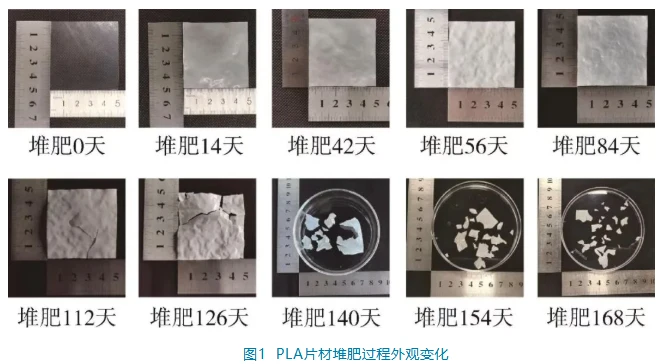
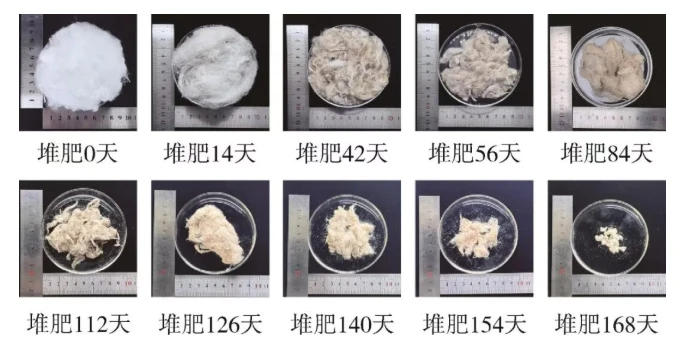
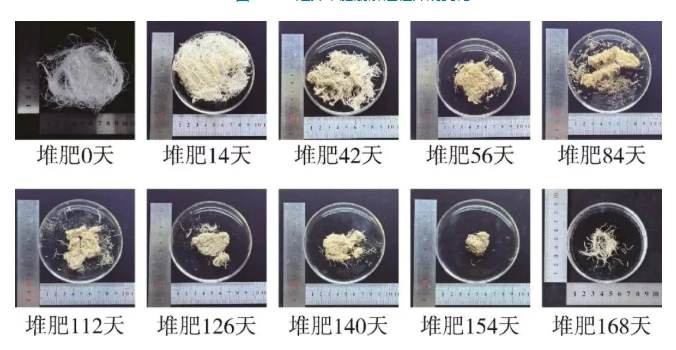
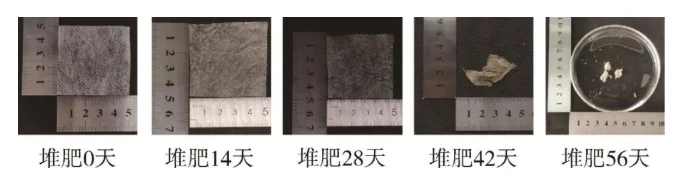
When the same batch of PLA products is buried in a compost bin, which will disintegrate into fragments first: sheets, long fibers, short fibers, or nonwoven fabric? Past research has mostly focused on single forms, lacking cross-sectional comparisons.
Recently, Professor Weng Yunxuan's team at Beijing Technology and Business University (Yao Ruobing, Yao Chenhao, Wang Qiong, etc.) published a study in *China Plastics*, systematically comparing the composting disintegration behavior of these four PLA forms for the first time under simulated strongly aerobic composting conditions (55±5℃, humidity 50%±10%), based on the GB/T 41639-2022 standard.
Results: Nonwoven fabric disintegrates fastest, sheets disintegrate slowest. After 58 days of composting, the nonwoven fabric disintegration rate reached 88.27%, ultimately achieving 100% complete disintegration. Short fibers and long fibers followed closely, with disintegration rates reaching 98.77% and 99.19% respectively after 168 days of composting; at this point, they were extremely brittle and crumbled into powder with a light touch. Sheets were the slowest, showing wrinkles after 14 days, large cracks after 112 days, and a disintegration rate of only 71.55% after 168 days. The four forms, ranked by disintegration speed, were: nonwoven fabric > short fibers > long fibers > sheets.
Reason: Specific surface area is the dominant factor. Why such a large difference? The key lies in specific surface area. The fiber structure of nonwoven fabrics, short fibers, and long fibers has a larger specific surface area, making it easier for microorganisms, moisture, and oxygen to penetrate and adhere, thus promoting hydrolysis, microbial degradation, and mineralization. The study also found that even when sheets and short fibers had similar molecular weights and crystallinity, short fibers still disintegrated faster, further confirming that specific surface area has a more significant impact on the disintegration rate.
Mechanism: Two Disintegration Pathways Coexist. At the mechanistic level, the disintegration pathways of the four PLA forms are completely consistent, with two pathways coexisting: one is molecular hydrolysis upon contact with water, resulting in the breakage of ester bonds and the formation of hydroxyl groups; the other is β-C-H hydrogen transfer leading to main chain breakage, generating carboxylic acid groups and vinyl esters.
Significance: This research provides quantitative support for "rapid degradation," offering a quantitative reference for composting treatment, product design, and degradation cycle prediction of PLA products. It also serves as important technical support for claims of "rapid degradation" in biodegradable packaging and fiber products. PLA's greenhouse gas emissions over its entire life cycle can be 30%–70% lower than traditional plastics; the faster the disintegration and the faster the closed-loop recycling, the more convincing the claim of "green" becomes.