Shellfish chemistry combines with polymers to create biodegradable adhesives
The most widely used and durable glue in the world has been found in the animal kingdom. For the past decade, researchers at Purdue University have been looking for sticky chemicals in coastal animals. Finally, they focused their research on mussels. Mussels are marine animals that can secrete a large amount of viscous substances, which inspired them to develop the next generation of adhesives.
The coastline is a changeable environment, and the adhesion ability provides a huge survival advantage for small organisms, which can resist the wear and tear of rain, wind and waves. Mussels can secrete a kind of glue, which contains a protein called cathechol. This protein is made of a special amino acid DOPA called dopa. It contains the chemicals needed to promote the "cross-linking" of protein molecules, providing strength and adhesion.
Researchers managed to replicate and enhance this mussel glue. They extracted its active ingredient catechol and inserted it into biomimetic polymers. The research team led by Jonathan Wilker, a chemistry professor at urdue University, developed a new adhesive.
They combined the bonding chemistry of shellfish with bio based polymers that can be extracted from corn. This adhesive is made by using the chemical properties of a compound called catechol, which is shown in the blue part of the chemical formula in the figure.
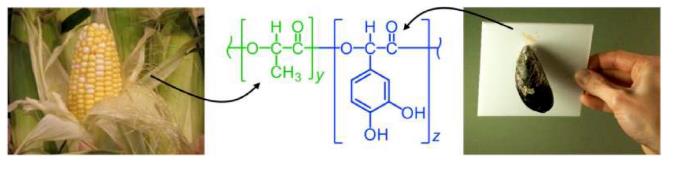
The researchers combined this binding chemistry of mussel protein with a polymer called polylactic acid or PLA, a bio based polymer that can be extracted from corn. This adhesive is made from the chemical properties of a compound called catechol contained in Doba.
This new mixed material is called poly catechol styrene or PCs. Its strength is 17 times that of the natural glue produced by mussels.
This bio based adhesive has excellent adhesion performance, which can be comparable with most petroleum based commercial glues, and is easy to degrade. It is a potential non-toxic substitute and has a very broad application prospect. It is expected to be applied in medicine, aerospace engineering, automobile, cosmetics and construction. Compared with petroleum based glue, biological based glue like this has strong competitiveness. They are not only degradable and renewable, but also have characteristics that heavy oil-based glue does not have.