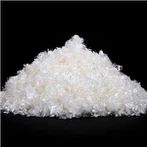
Polylactic Acid (PLA) fiber is fermented from carbohydrate-rich substances (such as long rice, sugar beets, cassava and other crops and organic waste) with certain strains of bacteria into lactic acid, and then undergoes cyclodimerization or dimerization of monomeric lactic acid. The direct polymerization of lactic acid produces a high-performance lactic acid polymer, and finally takes a certain spinning method to make PLA fibers. Because corn and other grains are mostly used as raw materials, it is also called "corn fiber". The raw material of PLA fiber comes from nature, and the product waste can be completely degraded into H2O and CO2 required by nature, realizing a complete natural cycle. It is a fiber material with great development prospects in the 21st century.
The process of polylactic acid fiber
1. Synthesis of PLA
Due to the existence of asymmetric carbon atoms in lactic acid, it can be divided into poly-L-lactic acid (PLLA), poly-D-lactic acid (PDLA) and poly-racemic lactic acid (PDLLA) according to its optical activity. The scope of application of PLA with low molecular weight is relatively narrow, and it is mainly used for slow-release materials, surgical sutures, etc., such as PLA microspheres, which can control drug release. High molecular weight PLA can be used for fiber materials or resins, so the main research at present is the synthesis of high molecular weight PLA, which is mainly divided into direct polymerization method and indirect polymerization method.
01 direct polycondensation
The direct polycondensation method includes the solution polycondensation method and the melt polycondensation method. Figure 1 shows the direct polycondensation reaction formula of polylactic acid. Masanobu Ajioka et al. prepared PLA with a molecular weight of 300,000 by solution polycondensation method. The lactide and organic solvent generated during the entire reaction process continued to participate in the reaction after being circulated, avoiding the degradation of polylactic acid. Japan's Mitsubishi Chemical Company has realized the industrial production of polylactic acid by solution condensation; Kimnra et al. have prepared PLA with a molecular weight of 500,000 by melt polycondensation using tin chloride dihydrate and p-toluenesulfonic acid binary catalyst system. The production process of the direct polycondensation method is simple, but due to impurities in the system and the lactic acid polycondensation reaction is a reversible reaction, it is difficult to obtain high molecular weight PLA.

Polylactic acid direct polycondensation reaction formula
02 indirect polymerization
Indirect polymerization, namely ring-opening polymerization, is the most well-studied and mature polymerization method so far, and it is also the most widely used method for producing PLA. Indirect polymerization is often used in the synthesis of PLA with high molecular weight and high stereoregularity. In 1932, Carothers first proposed the method of ring-opening polymerization of PLA by ring-opening dimer lactide, and the molecular weight of PLA prepared was as high as 700,000 to 1 million. Figure 2 shows the chemical reaction formula of polylactic acid ring-opening polymerization.

Polylactic acid ring-opening polymerization
2. PLA fiber forming
Melt spinning is a spinning method in which the polymer is heated and melted, extruded through the spinneret hole, and cooled and solidified in the air to form fibers. It is the most economical spinning method for polylactic acid so far.