


The Institute for Agricultural and Forest Systems in the Mediterranean (CNR-Isafom) of the Italian National Research Council, in collaboration with the University of Milan, has jointly developed a novel analytical protocol. This method enables the precise, low-cost identification of conventional plastics within compost, distinguishing them from compostable, biodegradable polymers.
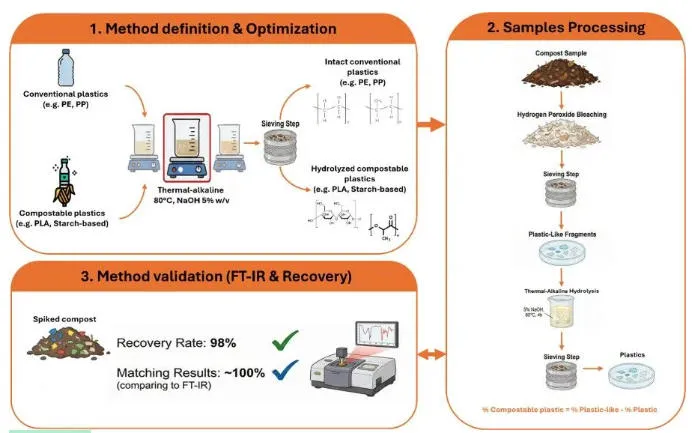
At the core of this technology is a selective alkaline hydrolysis process, which serves as the critical differentiating step: when compost samples are immersed in a sodium hydroxide solution at 80°C, compostable polymers dissolve completely, whereas conventional petrochemical plastics remain intact-resisting alkaline corrosion-and can subsequently be quantified. This cost-effective and practical solution assists organic waste treatment facilities in verifying compost quality and tracking the actual degradation performance of new biodegradable polymers.
Experimental Procedure: The study first established optimal process conditions for the selective hydrolysis of starch-based and polylactic acid (PLA)-based compostable plastics: a temperature of 80°C, a 5% (w/v) sodium hydroxide solution, and a hydrolysis duration of two hours-conditions that do not cause hydrolytic degradation of conventional plastics. Subsequently, hydrogen peroxide bleaching was employed to remove impurities such as stones, metals, glass, and plastic-like debris. The method was then used to differentiate between the two types of plastic residues in compost samples, with results validated through Attenuated Total Reflection-Fourier Transform Infrared (ATR-FTIR) spectroscopy.
Project researchers Mirko Cucina (CNR-Isafom) and Fabrizio Adani (University of Milan) noted that existing testing methods fail to distinguish between persistent petrochemical plastics and compliant compostable plastics in compost-even though compostable materials are legitimate feedstocks for the organic fraction of municipal waste. Precisely separating the two is no longer merely a technical challenge; it is a fundamental prerequisite for ensuring food safety and the sustainability of global supply chains.
Fabrizio Adani added that the new process overcomes the pain points of traditional testing methods-namely high costs, insufficient accuracy, and difficulties in scaling up. The material recovery rate reaches 98%, and the detection results have been validated via infrared spectroscopy. The complete analytical method was recently published in the journal *ACS Sustainable Chemistry & Engineering*.


