On June 24, the Japanese company Bioworks announced a joint development with Matsukawa Rapyarn-a textile company with a century-long history-to create high-density woven labels made entirely from "PlaX."
The apparel industry is currently accelerating efforts to reduce its environmental impact, with a continuous shift from petroleum-based fabrics to eco-friendly, sustainable alternatives. Simultaneously, there is a growing trend toward using a single material for all components of a garment-including the main fabric, labels, and decorative elements-to significantly enhance product recyclability.
Woven labels are crucial for conveying brand value and identity; however, the vast majority are currently made from petroleum-based polyester fibers, creating an urgent need for sustainable alternatives. "PlaX" is a bio-based polylactic acid (PLA) synthetic fiber independently developed by Bioworks. As a viable substitute for conventional polyester, PlaX is increasingly being adopted across various textile sectors.
United by a shared vision, the two companies are collaborating to accelerate the transition toward bio-based materials and a truly circular economy model-extending beyond the main garment body to include the accompanying accessories. By combining the sustainable potential of PlaX with Matsukawa Rapyarn's proprietary high-density weaving technology, they are expanding the boundaries of plant-based fabric applications-covering everything from brand labels to high-end jacquard fabrics-and opening up new avenues for product design.
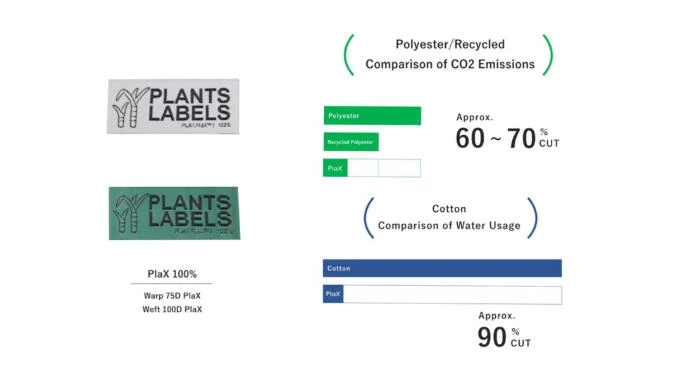
The newly developed woven labels utilize pure PlaX filament, featuring specifications of 75 denier for the warp and 100 denier for the weft. Leveraging Matsukawa Rapyarn's technical expertise, the process perfectly reproduces intricate details such as fine text and brand logos in high-precision woven labels.
In addition to high-density woven labels, the partners have also produced prototype jacquard fabrics using PlaX filament and expanded their range of yarn-dyed yarn samples. Jacquard fabrics allow patterns, logos, and graphics to be woven directly into the material; by leveraging novel plant-based materials, they unlock new possibilities for sustainable fashion design.
Key features of PlaX fiber:
• Compared to conventional polyester, carbon emissions from production are 70% lower for filaments and 50% lower for staple fibers;
• Compared to pure cotton, water consumption across the entire process-from raw material to spinning-is reduced by 92%;
• Industrial compostability: in an industrial composting environment, it can be completely broken down by microorganisms into water and carbon dioxide;
• Discarded fabric can be recycled into new raw material, facilitating the development and implementation of a closed-loop resource system;
• Lower carbon emissions during incineration, with no release of toxic or harmful substances such as dioxins;
• Leverages the inherent antibacterial properties of lactic acid to inhibit the proliferation of *Moraxella* and *Staphylococcus aureus* on the fiber;
• Also helps prevent odors.