Classification of compatibilizers
Compatibilizers can be divided into two categories: non-reactive compatibilizers and reactive compatibilizers, according to the interaction characteristics between the matrix polymers of compatibilizers.
1. Non-reactive compatibilizer
Non-reactive compatibilizers refer to those copolymers that do not contain reactive genes and do not participate in chemical reactions during polymer mixing. Compatibility by adding non-reactive compatibilizers in incompatible polymer systems is the most common method in polymer alloy technology.
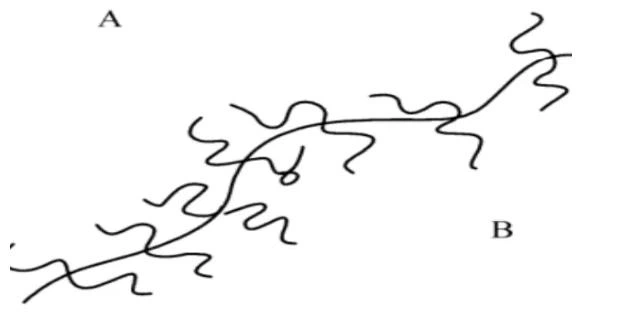
From a structural point of view, most of the non-reactive compatibilizers are block copolymers, graft copolymers or random copolymers, such as EAA, EEA, EVA, CPE, SEBS, etc.
This kind of compatibilizer is easy to mix and has less side reaction, but it needs to be added in a larger amount.
2. Reactive compatibilizer
The reactive compatibilizer mainly improves the compatibility by chemically reacting with the raw material polymer through its own reactive group during mixing. Most are block, graft or random copolymers containing active end groups.
It is generally a macromolecular type, and its active functional group can be at the end of the molecule or on the side chain of the molecule. Its macromolecular main chain can be the same as or different from at least one polymer matrix in the blending system. However, under different circumstances, its macromolecular main chain should have good compatibility with at least one polymer matrix in the blending system.

The terminal reactive groups of the reactive compatibilizer are mostly acid anhydrides, epoxy groups, and carboxyl groups, and the terminal reactive groups of the polymer to be compatibilized are amine groups, hydroxyl groups, and carboxyl groups.
The advantages of this type of compatibilizer are high action efficiency, less addition amount, and obvious effect, especially for systems that are difficult to be compatible. The disadvantage is that the side reaction is large, which will affect the processing performance and reduce the physical properties, and the price is high, and the requirements for mixing conditions are relatively high.
Typical reactive compatibilizers are:
(1) Reactive compatibilizers containing carboxyl groups;
(2) Reactive compatibilizers containing acid anhydrides;
(3) Reactive compatibilizers containing epoxy groups;
(4) Reaction compatibilizers containing oxazoline groups;
(5) imine reactive compatibilizer;
(6) Isocyanate reactive compatibilizers.
At present, the development of reactive compatibilizers has become the focus of compatibilization technology development.


