The volume of items handled by my country's postal and express delivery sector has grown steadily this year. Data shows that in the first 10 months, the cumulative volume reached 183.303 billion items-a year-on-year increase of 3.3%. Alongside this growth, express delivery packaging has undergone a transformation during this year's peak online shopping season, becoming more eco-friendly and lightweight. Recently, a reporter from CCTV News visited the China Post Green Packaging Innovation Laboratory.
Recently, a CCTV News reporter visited the China Post Green Packaging Innovation Laboratory.
When the reporter arrived at the Green Packaging Constant-Temperature and Constant-Humidity Laboratory at the China Post Research Institute, researchers were in the process of testing adhesive tape. Experts explained that the testing focuses on the tape's tensile strength and elongation at break, ensuring it possesses sufficient toughness and durability to prevent splitting or tearing during the delivery process.
Researchers noted that this is the third generation of biodegradable tape. This year, the team not only reduced the amount of printing ink used on the tape by 50% but also overcame a technical challenge-the tendency for such tapes to lose their stickiness in low temperatures. Through hundreds of rounds of adhesion testing and over forty adjustments to the adhesive formula, the team significantly enhanced the tape's holding power, extending it from the original 2 hours to over 40 hours. Compared to the previous version, this third-generation product is slightly more cost-effective. It is currently being piloted in regions including Beijing and Fujian, with further cost reductions expected once large-scale mass production begins.
In another chemical laboratory, the reporter observed a bio-based, fully biodegradable bubble mailer-an innovation pioneered by China Post. Development staff explained that these mailers are primarily used for specialized delivery needs, such as official documents, license plates, and government-related correspondence, with an annual demand exceeding 80 million units. In the early stages of development, the team used standard biodegradable material formulas; while these met biodegradability requirements, they lacked sufficient strength and cushioning performance. Kang Li, head of the China Post Green Packaging Innovation Laboratory, noted that the development process involved overcoming numerous technical hurdles. It employs a four-layer structure, with each layer consisting of materials that have distinct melting points. By carefully calibrating the composition of each layer, the materials are engineered to harmonize during the lamination process; this ensures their melting points align, resulting in a unified, cohesive sheet that is then fashioned into a complete packaging bag.
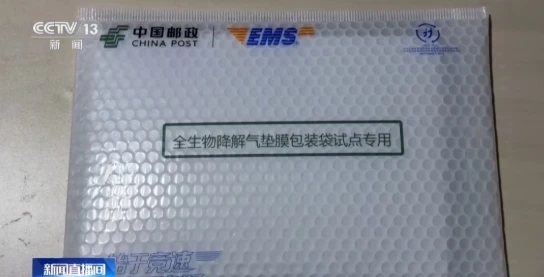
Following rigorous, iterative testing-along with refinements to both the materials and the production formulas-the new product boasts a 40% increase in strength, while production costs have been reduced by 30% compared to previous biodegradable packaging options. According to Kang Li, the new product has already undergone successful pilot testing across eight provinces. A nationwide rollout across the postal and express delivery network is anticipated for next year.
As the postal and express delivery sector continues to evolve, 11 new products have been developed this year and promptly introduced for pilot use in the market. From bamboo-pulp cartons and bamboo-based waterproof bags to fully biodegradable narrow adhesive tape, reusable delivery bags, and the integration of photovoltaic (solar) green energy, the "greening" of the express delivery industry is expanding well beyond just packaging to encompass the entire logistics and transit chain.