


Israeli company launches first polylactic acid (PLA) made from food waste
Israeli startup TripleW and Sulzer have recently partnered to launch the world's first polylactic acid (PLA) bioplastic made entirely from food waste. This global breakthrough marks a new era of sustainable innovation, transforming food waste into high-value bioplastics and fully supporting the circular economy.
TripleW converts food waste into lactic acid, while Sulzer's technology converts lactic acid into polylactic acid (PLA) bioplastic on a large scale.
This new polylactic acid (PLA) is made from food industry byproducts, including baking waste and expired food, transforming underutilized waste into high-performance bioplastics.
"Supporting TripleW in validating and scaling up its PLA process for producing lactic acid from food waste is a unique milestone in the history of PLA," said Virginie Bellière-Baca, Global Head of Technology and Innovation at Sulzer. "We believe the industry will benefit greatly from utilizing a wide range of biopolymer feedstocks, and we look forward to implementing this process on a larger scale."
This milestone is the result of collaboration within the CIRCLE consortium, funded by the Circular Biobased Joint Undertaking in Europe (CBE JU). The CIRCLE consortium aims to establish a fully integrated value chain for bio-based materials derived from food waste by uniting industry partners. This revolutionary PLA bioplastic derived from food waste can now be effectively utilized by consortium partners and global brands to replace fossil-based materials in textiles, packaging, and consumer goods.
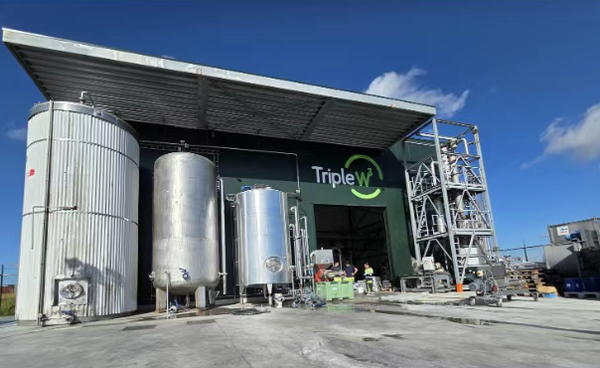
TripleW has officially opened its demonstration plant in the Next Gen District of the Port of Antwerp, Belgium, which can process 10 tons of waste per day to produce lactic acid.
TripleW is not the only company producing lactic acid from food waste. "But we are the first to do so at scale," said Shapira, co-founder and CEO of TripleW. "We also plan to build a commercial-scale lactic acid production plant on an adjacent site: increasing the daily processing capacity from 10 to 300 tons."
So far, the demonstration project has received €10 million in investments, and commercial production requires an investment of €70 million. To achieve this goal, TripleW is seeking support from Belgian companies.


