On May 22, 2026, a consortium led by Mitsubishi Chemical Corporation, with participation from companies including Komin, Dongxing Metal, REFINVERSE, Mitsubishi Electric, digglue, Nippon Polypropylene, and RHOMBIC, and Toyota Motor Corporation as a partner, officially launched a feasibility study for a centralized hub for post-consumer plastic recycling.
This project has been selected for the Japanese Environment Agency's "2025 Supplementary Budget – Feasibility Study Subsidy Program for a Stable Supply System of Recycled Plastics in the Automotive Industry," and the study will continue until February 2027.
In recent years, Europe has continuously tightened regulations on the use of recycled materials in the automotive sector. However, Japan has not yet established a high-quality recycled supply system for post-consumer plastics, and the application of recycled materials in automobile manufacturing is extremely limited. Therefore, this feasibility study aims to establish a centralized hub to achieve advanced sorting, digital traceability, and a stable supply, ultimately forming a replicable business model.
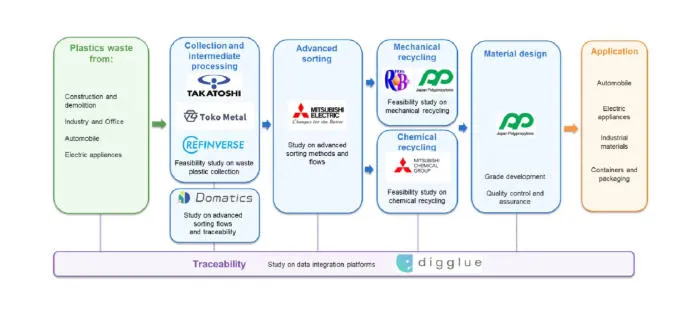
This research covers five core areas: first, developing a high-precision sorting solution for post-consumer plastics using digital technology and AI; second, assessing the availability of recycled materials to meet automotive quality requirements; third, exploring chemical recycling pathways for waste plastics unsuitable for mechanical recycling; fourth, identifying data integration requirements to ensure traceability; and finally, evaluating economic viability and estimating the hub's incremental contribution to the supply of recycled plastics, while developing a phased implementation roadmap.
This consortium adopts an "artery-vein industry collaboration" model. The vein industry is responsible for the collection and sorting of post-consumer plastics, while the artery industry is responsible for material design, blending and modification, and supply to end users. By combining advanced sorting with material design, tiered utilization of mechanical and chemical recycling, and a traceability platform to improve supply chain transparency, the consortium aims to develop recycled materials that meet stringent automotive quality standards.
After the research, the consortium plans to advance system construction and, depending on the results, move to the pilot or commercialization phase.