


From August 12, 2026, the EU Packaging and Packaging Waste Regulation (PPWR, (EU) 2025/40) will be fully implemented. The regulation covers requirements for recycling rates, recycled content, reusable packaging, and more. In the definition of "compostable packaging" and the revised harmonized standards, anaerobic digestion has been explicitly included as a legally mandated decomposition pathway. This adjustment has a direct impact on biodegradation testing standards and compliance pathways. This article discusses the relevant regulatory provisions, the progress of standard revisions, and the current status of anaerobic degradation testing standards.
Definition Level: Anaerobic Digestion Included in the Definition of "Compostable Packaging"
Prior to PPWR, "compostable" in the old Packaging Directive 94/62/EC and EN 13432:2000 mainly referred to the aerobic composting process. In Article 3, point (50), PPWR defines "compostable packaging" by including anaerobic digestion:
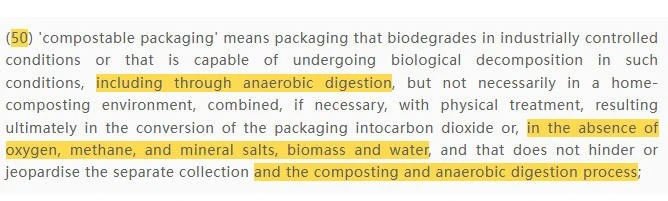
Several key points can be gleaned from the definition:
"including through anaerobic digestion"-clearly including anaerobic digestion in the degradation pathway;
"in the absence of oxygen, methane, and mineral salts, biomass and water"-the packaging is ultimately converted into carbon dioxide (or methane and carbon dioxide under anaerobic conditions), as well as mineral salts, biomass, and water;
it also requires that the packaging must not hinder the sorting, collection, composting, and anaerobic digestion processes.
So, which packaging must be required to meet compostability requirements? Article 9 (1) clarifies the scope:
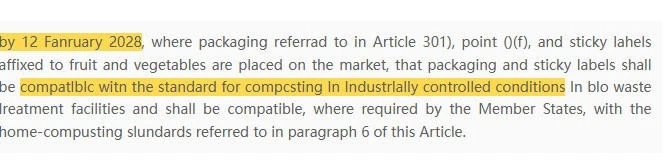
The packaging referred to in Article 3 (1)(f) refers to single-cup beverage system packaging such as tea bags and coffee bags. That is to say, from February 12, 2028, packaging such as tea bags, coffee bags, and fruit and vegetable adhesive labels must meet the compostability requirements under controlled industrial conditions, and the aforementioned definition of "compostable" already covers the anaerobic digestion pathway.
Standard Revision Level: The revision of EN 13432 has entered the substantive stage. After the regulatory definition adjustment, the revision of supporting harmonized standards is a key link in implementation. PPWR Article 9(6) has clear requirements in this regard:
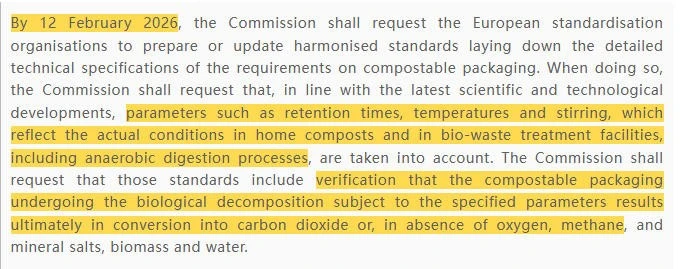
Key points summary:
• The committee must submit a revision request to the European Organization for Standardization by February 12, 2026;
• It is clearly required to include actual parameters of the anaerobic digestion process (retention time, temperature, agitation);
• The standard is required to verify that the final product is converted into carbon dioxide (methane and carbon dioxide under anoxic conditions), as well as mineral salts, biomass and water; Regarding the validity of the current standard: Recital (58) clarifies that the current industrial composting standard EN 13432:2000 cannot be used as a basis for presumption of conformity and needs to wait for the release of a revised and updated version; before the release of the new standard, the current standard can be used as guidance.


