


On April 10, the Japan Agency for Marine-Earth Science and Technology, the University of Tokyo, and the Tokyo University of Science announced that they had successfully made cardboard transparent. This transparent cardboard is made of cellulose, the same main component as ordinary cardboard, and is an environmentally friendly material. It can not only be used for flat boards, but can also be processed into three-dimensional shapes such as cups and straws. In addition, since the waste liquid generated during the manufacturing process can be recycled, the production of transparent cardboard can be completed without external discharge. What is more worth mentioning is that this technology can also regenerate new transparent cardboard from transparent cardboard through material recycling. Even if it flows into the ocean due to unexpected circumstances such as heavy rain or typhoons, microorganisms in seawater can degrade it and avoid long-term residue in the marine environment. This developed ocean-friendly material is expected to become a key solution to replace packaging containers that cause marine plastic pollution.
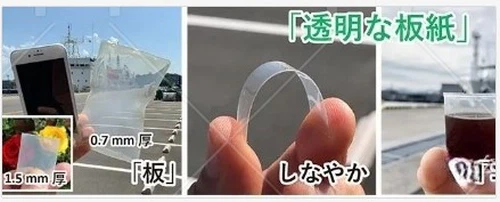
The research team successfully developed "transparent cardboard" using the same plant-derived cellulose component as ordinary cardboard. The material exhibits excellent light transmittance while maintaining a thickness of 0.3-1.5mm (equivalent to or 5 times thicker than ordinary cardboard). Especially within the commonly used packaging thickness range of 0.3-0.7mm, the haze value is less than 30%, and objects a hundred meters away can still be clearly identified even through the cardboard.
Its hardness and strength tests show that it exceeds hard plastics such as polycarbonate, and can be processed into three-dimensional shapes such as straws and cups. Since the wet strength is significantly higher than that of ordinary cardboard, it can hold liquids without treatment.
Although cups made of this material will leak slightly after three hours, after adding a plant-based resin coating, the material contact angle exceeds 90 degrees, which improves its ability to retain liquid and achieves the dual functions of light transmission and waterproofing.
This transparent cardboard is made by the following steps: (1) melting cellulose at high temperature and leaving it at room temperature to harden, (2) rinsing with water, and (3) drying. In step 1 of dissolving the cellulose, a lithium bromide aqueous solution is used as a solvent. The waste liquid generated during water washing in step 2 is a lithium bromide aqueous solution diluted with water. By concentrating the solution, it can be reused as a solvent in step 1. In addition, the water generated by concentration can also be used in the washing process of step 2. This proved the feasibility of a closed manufacturing process that has minimal impact on the environment and does not discharge any waste liquid to the outside. The transparent cardboard can also be crushed and reshaped into transparent cardboard, which is a simple recycling process, but the transparency of the material will be reduced.
Finally, the biodegradability of transparent cardboard in the marine environment was verified. In particular, considering the low water temperature and small number of microorganisms in the deep sea where the garbage will eventually accumulate, its biodegradability must be accurately evaluated by long-term placement in the actual deep sea environment. To this end, the research team used a variety of equipment owned by the Marine Science and Technology Development Agency, including the manned submersible survey ship "Shinkai 6500", the unmanned probes "Dolphin" and "KM-ROV", and the free-fall lander "Edoko No. 1", to complete the layout, recovery and high-precision analysis of transparent cardboard. In all deep-sea areas where the test was conducted, the transparent cardboard showed a decrease in weight.
To clarify whether this weight loss was caused by microbial action, electron microscopy observation and metagenomic analysis found that perforations formed by attached microorganisms were visible on the surface of transparent cardboard recovered from the deep sea. Metatranscriptome analysis showed that these enriched microorganisms were able to produce enzymes involved in cellulose decomposition, such as cellulase and β-glucosidase. This confirmed that even in deep-sea environments, cellulose-degrading microorganisms promote the biodegradation of transparent cardboard. Although the rate of deep-sea biodegradation slows down with increasing water depth, the degradation of transparent cardboard was observed on the deep seabed of all test areas. Based on the measured degradation rate, it was calculated that in deep-sea areas with a water depth of about 700-1000 meters, cups made of this transparent cardboard can be completely degraded within 6 months to 1 year. When the researchers observed the degradation process through time-lapse photography at a depth of 757 meters in Misaki-oki, Sagami Bay, they confirmed that the cups made of transparent cardboard almost completely disappeared within 4 months.
This study successfully developed a friendly material called "transparent cardboard" that meets the three basic conditions of the next generation of universal materials: (1) biomass-derived; (2) recyclable; and (3) marine biodegradable. Transparent cardboard is expected to become a trump card to replace existing plastics, but there are still many obstacles to overcome before it can be put into practical use. In particular, through the calculation of manufacturing energy consumption, it was found that in order to achieve large-scale production and cost control, it is necessary to establish a "continuous production process" and "efficiently recycle and reuse waste solvents." In particular, the results of production energy calculations show that "establishing a continuous production process" and "improving the efficiency of recycling and reuse of waste solvents" are crucial to expanding production scale and reducing production costs. The researchers said that the future goal is to overcome these challenges and replace plastics with transparent cardboard in applications where transparency is crucial.


