


Poly(butylene succinate) (PBS) is a biodegradable thermoplastic polyester that can be processed via injection molding and fused deposition modeling (FDM).However, neat PBS exhibits a relatively low modulus (approximately 0.36 GPa) and significant thermal warping during printing and injection molding, which limits its application in structural components.
A research team at the University of Georgia addressed this by incorporating a biorefinery byproduct-specifically, residue from consolidated bioprocessing (CBP)-into the PBS matrix as a lignin-enriched filler. Through high-shear homogenization to achieve interfacial reinforcement, they produced a PBS-based biocomposite suitable for both 3D printing and injection molding.
Raw Materials and Pretreatment
The CBP residues were derived from two lignocellulosic feedstocks: switchgrass and poplar. The CBP process integrates saccharification and fermentation into a single step; upon completion, most carbohydrates have been consumed by microorganisms, resulting in a significantly higher lignin mass fraction in the remaining residue, alongside partial structural breakdown and fiber size reduction.
Compared to the original biomass, the residue exhibits two key changes:
• Enhanced hydrophobicity. The selective removal of carbohydrates reduces the density of polar groups on the residue surface, improving compatibility with the hydrophobic PBS matrix.
• Reduced moisture sensitivity. Low hygroscopicity minimizes the formation of bubbles and interlaminar defects caused by moisture vaporization during processing.
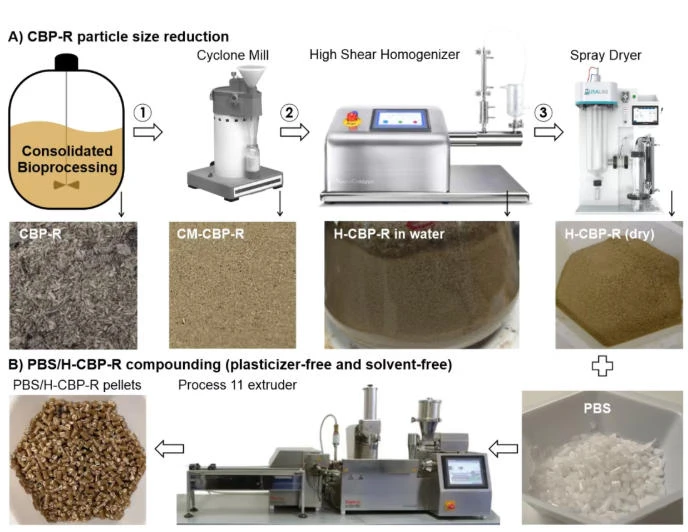
Core Process: High-Shear Homogenization (HSH) Instead of employing coupling agents or chemical grafting, the research team utilized high-shear homogenization to physically process the CBP residues:
1. Disperse the dried CBP residues in an aqueous medium;
2. Process the mixture using high-shear homogenization equipment, leveraging shear forces, cavitation, and turbulence to dissociate fiber bundles into micron-scale particles and microfibers;
3. Induce physical activation on the filler surface during homogenization (increasing surface roughness and specific surface area), which facilitates mechanical interlocking with the PBS melt;
4. Dry-blend the homogenized filler with PBS pellets at the target ratio, followed by twin-screw extrusion and pelletization.
This process eliminates the use of organic solvents and the generation of chemical modification by-products; furthermore, the equipment requirements are compatible with conventional plastic blending lines.
Economic and Environmental Impact
Accompanying techno-economic analysis (TEA) and life cycle assessment (LCA) provided quantitative findings:
The minimum selling price for the composite with a 30 wt% filler loading is approximately $4.07/kg, which is lower than the benchmark price of ~$5.00/kg for conventional bioplastics;
Capital equipment depreciation is the primary driver of production costs; increasing the solids content during processing can directly reduce equipment requirements per unit of production capacity;
Global Warming Potential (GWP) did not significantly increase with the addition of residues, as emissions associated with organic solvent production and waste landfilling were avoided.
Conclusion
The core contribution of this study lies in demonstrating that biorefinery residues, following physical homogenization, can serve directly as functional fillers for PBS without the need for chemical modification. The process is simple, yields clear performance improvements, and is economically viable. Theoretically, this approach can be extended to other lignocellulosic residues and thermoplastic matrices.


