Nippon Shokubai is currently advancing the commercialization of a new marine-biodegradable plastic. Based on poly(ethylene succinate) (PES) and incorporating a long-chain dicarboxylic acid structure, this material has been launched under the new brand, LUNARE® SE-S series. The lineup includes SE-S-01-a standalone material-as well as SE-S-51, a blend containing polylactic acid (PLA).
Chemical structure of SE-S-01

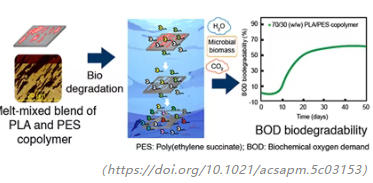
SE-S-01 is inherently biodegradable in soil, river, and marine environments. When blended with PLA (at a concentration of approximately 30%), it facilitates the marine biodegradation of the PLA. Furthermore, because SE-S-01 is flexible, it helps mitigate the inherent rigidity and brittleness of PLA. Consequently, Nippon Shokubai is promoting the material as an additive designed to both enhance marine biodegradability and improve the physical properties of PLA-based products.
Both SE-S-01 and SE-S-51 have received certification for biodegradability and marine biodegradability from the Japan BioPlastics Association (JBPA).
Nippon Shokubai is currently supplying the material to domestic and international clients for evaluation using their own production equipment to manufacture items such as films, injection-molded parts, and non-woven fabrics. Several successful trials have already met client expectations for molding performance. These molded products are now undergoing assessment for biodegradability in marine and other environments, bringing the material close to full-scale commercial application.
Regarding production capacity, Nippon Shokubai is collaborating with a polyester manufacturer to establish a manufacturing process using industrial-scale equipment. The initial focus is on building a supply system for SE-S-01 pellets, with a goal of completing pilot-scale validation within the 2026 fiscal year. Future plans may also include the supply of pre-blended pellets-a mixture of the material and PLA-directly to customers.